What Does Greatness Mean to You? My personal take on basketball greatness — looking beyond stats and championships to the stories, influence, adversity, competition and legacies that made these players unforgettable.
I went down a rabbit hole recently trying to answer one of basketball's impossible questions:
Who are the greatest NBA players of all time?
At first, I approached it the way most of these conversations go.
Championships. MVPs. Finals MVPs. Statistics. Longevity. Peak performance.
But the more I researched the history of the game and the careers of different players, the more I realized something.
That's not actually how I define greatness.
Because when I think about why I love basketball, I don't remember a spreadsheet.
I remember stories.
I remember rivalries.
I remember players losing, coming back and trying again.
I remember moments that made you feel something.
I remember watching someone accomplish something that seemed impossible.
And I remember players who made you want to pick up a basketball yourself.
So this isn't meant to be *the* definitive greatest-player ranking.
It's my personal ranking.
I've tried to ground my opinions in what I found researching the players, their accomplishments and NBA history. But what you choose to value is ultimately subjective.
And what I discovered is that I value something much bigger than statistics.
So what does greatness mean to me?
I ended up looking at seven things:
Greatness — 20%
How dominant were you? At your absolute best, how great were you compared with everyone else?
Basketball legacy — 15%
What did you leave behind? How will basketball remember you after the statistics are forgotten?
Global and cultural impact — 15%
Did you make people care about basketball? Did you inspire people beyond your city, country or generation?
Influence and innovation — 15%
Did basketball change because you existed? Did players imitate you? Did coaches change strategies? Did you push the game somewhere new?
Story, adversity and inspiration — 15%
What was your journey?
Did we see you struggle? Fail? Get knocked down? Come back?
And did watching that journey teach people something about pursuing greatness themselves?
Competitive legacy — 10%
This one is particularly personal to me.
I love competition.
I value players who wanted to overcome their rivals. Players who accepted difficult situations and came back better when they lost.
I'm less inspired by taking the easiest path available.
I'm also not a fan of some things that have become more prominent in modern basketball: excessive foul-baiting, flopping, constantly complaining to officials, or treating contact as something to avoid rather than part of competition.
That's subjective.
But it's part of what I personally value about sport, so it's part of my definition of greatness.
**Individual accolades — 10%**
Championships, MVPs, Finals MVPs, scoring titles, defensive awards and records obviously still matter.
They just don't tell the entire story.
After putting all of that together, I ended up with this:
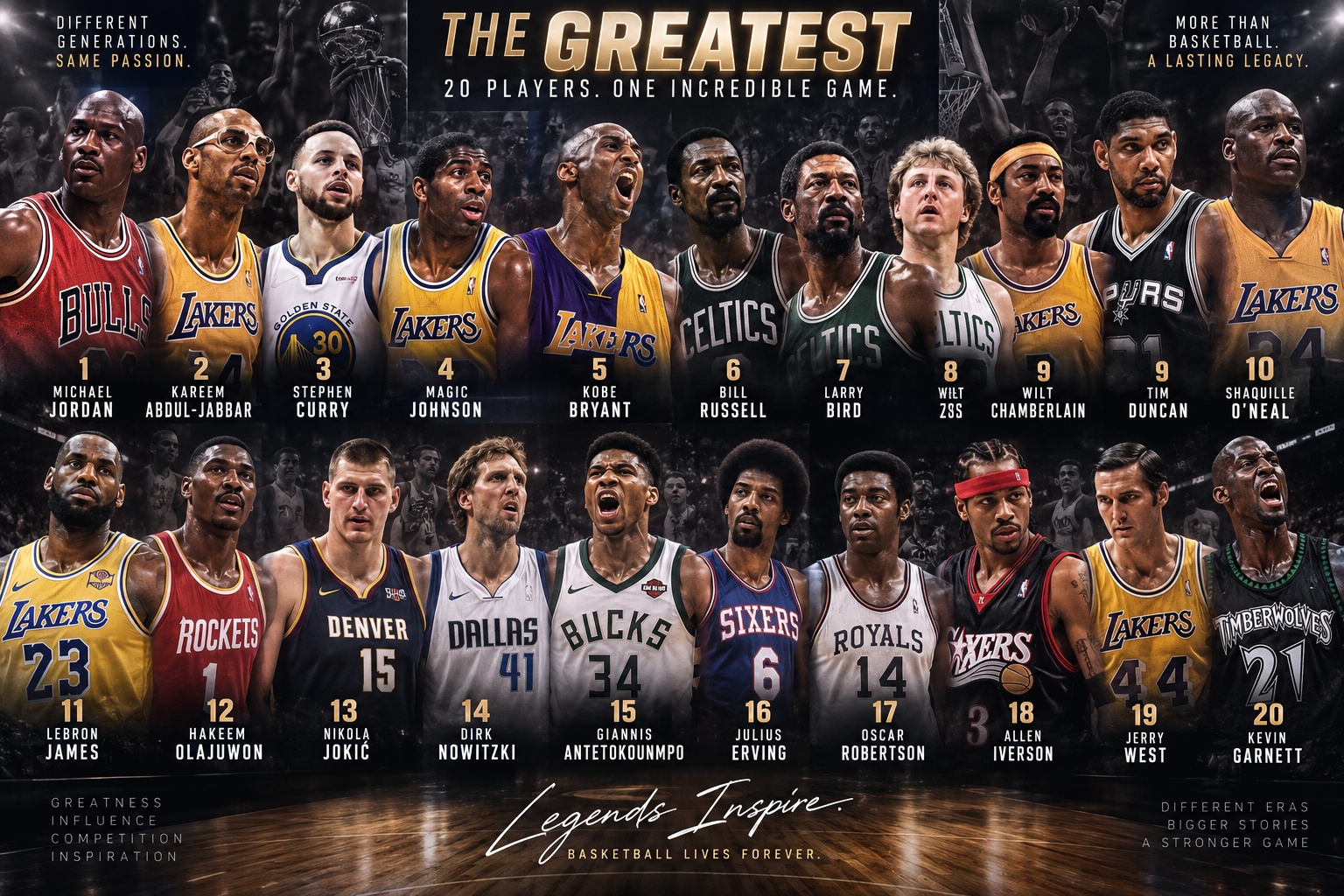
My Top 20
1. Michael Jordan**
2. Kareem Abdul-Jabbar**
3. Stephen Curry**
4. Magic Johnson**
5. Kobe Bryant**
6. Bill Russell**
7. Larry Bird**
8. Wilt Chamberlain**
9. Tim Duncan**
10. Shaquille O'Neal**
11. LeBron James**
12. Hakeem Olajuwon**
13. Nikola Jokić**
14. Dirk Nowitzki**
15. Giannis Antetokounmpo**
16. Julius Erving**
17. Oscar Robertson**
18. Allen Iverson**
19. Jerry West**
20. Kevin Garnett**
And there are a few rankings here that probably need explaining.
1. Michael Jordan — The Standard
Jordan is #1 for me because nobody combines all of these categories quite like him.
Six championships.
Six Finals MVPs.
Five MVPs.
Ten scoring titles.
Defensive Player of the Year.
But those accomplishments alone aren't why I have him first.
It's the journey that gives the accomplishments meaning.
Before Jordan became the Jordan we remember, he lost.
Detroit beat him.
They physically punished him.
The Bulls couldn't get past them.
So Jordan went back to work.
He got stronger.
He came back.
And eventually he overcame them.
That's what I love about the story.
The championships weren't inevitable.
They were earned through failure.
And that's something Jordan represented incredibly well.
Talent matters.
But talent isn't enough.
How hard will you work?
How badly do you want it?
What happens when someone beats you?
Do you find an easier route?
Or do you come back better?
Then you add the global impact.
Air Jordan.
"Be Like Mike."
The shoes.
The commercials.
The countless kids around the world pretending the clock was running down:
"3...2...1... Jordan!"
Jordan didn't just become basketball's biggest star.
He helped make basketball global.
For my definition of greatness, he's the standard.
2. Kareem Abdul-Jabbar — Sustained Greatness
Kareem represents a different kind of greatness.
Six championships.
Six MVPs.
Two Finals MVPs.
Nineteen All-Star selections.
And perhaps the most iconic unstoppable shot basketball has ever seen: the skyhook.
But what amazes me most is the span of his career.
He entered the NBA in 1969.
He retired in 1989.
Think about how much basketball changed during those twenty years.
Different opponents.
Different teammates.
Different styles.
Different generations.
And Kareem remained great.
There's something inspiring about that too.
Reaching the top is difficult.
Remaining there while the world around you changes might be even harder.
3. Stephen Curry — The Revolutionary
This is probably my first controversial choice.
I have Curry third.
Not because I necessarily believe Steph is the third-most naturally gifted basketball player ever.
I have him here because very few players can genuinely say:
**Basketball changed because of me.**
Curry didn't invent the three-pointer.
Great shooters existed long before him.
But he completely changed our understanding of what constituted a good shot.
Thirty feet from the basket?
Pull-up three in transition?
Defender goes under a screen?
Shoot.
Defenses had to extend farther from the basket.
Spacing expanded.
Big men increasingly had to defend on the perimeter.
Young players began practicing shots coaches once would have immediately discouraged.
And Curry didn't just make it entertaining.
He proved you could win championships that way.
His 2016 season remains one of the most extraordinary individual seasons I've watched: 30.1 points per game, 402 three-pointers, 73 team wins and the first unanimous MVP in league history.
His story matters too.
He wasn't built like Shaq.
He didn't have LeBron's physical gifts.
He had significant ankle problems early in his career.
And yet this relatively undersized guard eventually forced the entire sport to adjust to him.
That's inspiring in its own way.
Sometimes greatness isn't overpowering everyone.
Sometimes it's becoming so good at your craft that the world eventually has to change around you.
4. Magic Johnson — Basketball Can Be Fun
Magic changed what we thought a point guard could look like.
At 6'9", he shouldn't have been doing what he was doing.
Rebound.
Push the ball himself.
Run the break.
Post smaller defenders.
Create.
Pass.
Control an offense.
But Magic's legacy is also inseparable from Larry Bird.
Lakers versus Celtics.
Showtime versus Boston.
Magic versus Bird.
Their rivalry helped elevate the NBA because people wanted to see them compete against one another.
They didn't need to remove the rivalry.
The rivalry was the attraction.
Magic also later faced one of the most significant personal challenges any superstar athlete has publicly experienced with his HIV diagnosis, becoming an enormously important public figure beyond basketball.
His legacy is much larger than five championships.
5. Kobe Bryant — Mamba Mentality
This is probably the ranking I feel most strongly about after thinking through what greatness actually means to me.
If we only use efficiency metrics or advanced statistics, Kobe can slide down historical rankings.
But if we're talking about **legacy, inspiration, competition and story**, I can't put him that low.
Because Kobe gave basketball something bigger than his statistics.
He gave us:
Mamba Mentality.
Kobe entered the NBA at 18.
He wasn't immediately the finished superstar we remember.
There were failures.
There were those famous airballs against Utah.
There was the complicated partnership with Shaq.
There were championships.
There was the breakup.
There were years of criticism.
Could Kobe win without Shaq?
Then came the 2008 Finals loss to Boston.
Kobe came back.
Won in 2009.
Then got Boston again in 2010.
And this time he beat them.
Later came the Achilles injury.
He tore it, walked to the free-throw line, made his free throws and walked off.
And then somehow, at the end of everything, he finished his final NBA game with 60 points.
That's a story.
But what Kobe really left behind was his approach to improvement.
The preparation.
The repetition.
The footwork.
The conditioning.
The film study.
The obsession with getting better.
"Mamba Mentality" became a phrase people started using outside basketball.
Business.
Fitness.
School.
Personal goals.
Life.
The message was simple:
You can't control how naturally talented everyone else is.
But you can control how prepared you are.
You can control how hard you work.
You can control what you do after failure.
And you can decide how badly you want to become great.
That inspired an entire generation.
And for me, inspiration is part of greatness.
6. Bill Russell — Winning
Eleven championships.
It's almost impossible to process.
But Russell's greatness wasn't simply collecting rings.
He transformed defensive basketball.
Rim protection.
Help defense.
Anticipation.
Turning blocks into possessions.
Using defense to create transition offense.
And underneath all of that was a team-first approach to winning.
Some players leave records.
Russell left a standard.
7. Larry Bird — Rivalry
Three championships.
Three consecutive MVPs.
Two Finals MVPs.
But again, I love the story.
Bird versus Magic.
Boston versus Los Angeles.
Two completely different personalities and styles competing for basketball supremacy.
Bird was also remarkably modern.
Shooting.
Passing.
Rebounding.
Decision-making.
Creating offense from the forward position.
And the trash talk was legendary.
If you were going to talk, you had better back it up.
Bird usually did.
8. Wilt Chamberlain — The Phenomenon
100 points.
50.4 points per game for an entire season.
22.9 rebounds per game across his career.
Those numbers still look fake.
Wilt's dominance was so extreme that basketball itself had to react.
Very few athletes can say the sport had to reconsider how it operated partly because of their existence.
Wilt can.
9. Tim Duncan — Greatness Without Noise
Five championships.
Nineteen seasons.
One franchise.
No circus required.
Duncan adapted.
His teammates changed.
His role changed.
His body aged.
And San Antonio kept winning.
I love what Duncan's story represents.
You don't have to constantly tell everyone you're great.
You don't need to make yourself bigger than the team.
You can simply do the work and keep winning.
10. Shaquille O'Neal — The Force
At his peak, Shaq was almost an unsolvable basketball problem.
Teams carried enormous centers simply because eventually they might have to play him.
Extra bodies.
Extra fouls.
Double teams.
Hack-a-Shaq.
And from 2000–2002:
Three championships.
Three Finals MVPs.
Three years where the league essentially had to ask:
"What exactly are we supposed to do with this guy?"
Some players influence basketball because everyone copies them.
Shaq influenced basketball because **nobody could copy him, so everyone had to figure out how to survive him.**
11. LeBron James — Extraordinary Greatness, Complicated Legacy
Let me be very clear here.
LeBron James is unquestionably one of the greatest basketball players ever.
Four championships.
Four MVPs.
Four Finals MVPs.
The NBA's all-time leading scorer.
Extraordinary longevity.
Elite scoring and playmaking.
Championships with three different franchises.
If my criteria were purely basketball ability, statistics and longevity, LeBron would be much higher.
He also helped accelerate positionless basketball.
A player built like a power forward could effectively become your point guard.
That's enormously influential.
But this is where my personal definition matters.
I value the story created by overcoming rivals.
I love:
Lose.
Learn.
Improve.
Come back.
Try again.
Eventually overcome them.
The player-empowerment era that LeBron helped define can be viewed positively. Players gained greater control over their careers, and there is a legitimate argument that they should have that power.
But as a fan, I personally don't find stars engineering ideal situations together as compelling as rivals trying to beat one another.
That doesn't erase LeBron's accomplishments.
It simply affects where I place his **overall basketball legacy** under my criteria.
Someone else can reasonably use different criteria and rank him #1 or #2.
That's completely fine.
This is why this is my list rather than *the* list.
12. Hakeem Olajuwon — The Craftsman
Hakeem represents mastery.
His footwork remains basketball education decades later.
Players still seek out his knowledge.
But he wasn't merely an offensive technician.
He was one of the greatest defensive players ever.
Two championships.
Two Finals MVPs.
An MVP.
Two Defensive Player of the Year awards.
And one of the greatest two-way peaks basketball has seen.
His legacy lives every time a young big starts learning post footwork.
13. Nikola Jokić — Reinventing the Center
Jokić's story is still being written.
But he's already changed our understanding of what a center can be.
Traditionally, the center finished the offense.
Jokić can **be the offense**.
Rebound.
Initiate.
Pass.
Screen.
Run handoffs.
Score inside.
Shoot outside.
Manipulate an entire defense.
And there's something wonderful about his journey too.
A second-round pick becoming the best player in the world.
No superhero physique.
No overwhelming athleticism.
Just extraordinary basketball intelligence and skill.
14. Dirk Nowitzki — The Championship Journey
Dirk moves higher for me once story becomes part of the equation.
Because his story is fantastic.
He lost the 2006 Finals after Dallas went ahead 2–0.
Then came 2007.
MVP.
67 wins.
And one of the most embarrassing first-round playoff defeats ever, against the eighth-seeded Warriors.
For years, people questioned whether a jump-shooting European big could really be the best player on a championship team.
Dirk stayed.
Kept competing.
And then came 2011.
Dallas went through Kobe's defending champions.
Then Durant, Westbrook and Harden.
Then LeBron, Wade and Bosh.
And Dirk finished the job.
Statistically, that championship counts exactly the same as every other championship.
Emotionally, it doesn't.
The journey gives the achievement its meaning.
And Dirk also helped revolutionize basketball by proving that a seven-footer didn't need to live near the basket.
Modern stretch bigs are part of his legacy.
15. Giannis Antetokounmpo — Stay, Improve, Overcome
This is one of my favourite modern basketball stories.
Look at Giannis when he entered the NBA.
Raw.
Skinny.
Talented, obviously — but nowhere close to the player he eventually became.
Then you watch the transformation.
He gets stronger.
Gets better.
Becomes an MVP.
Then he loses.
Milwaukee suffers painful playoff exits.
Questions start appearing.
Can Giannis actually be the best player on a championship team?
Instead of searching for an easier situation, he committed to Milwaukee.
Kept working.
Then came 2021.
Milwaukee falls behind Phoenix 0–2 in the Finals.
They come back.
Game 6.
Giannis scores **50 points.
Milwaukee wins its first championship in 50 years.
That's exactly the kind of journey I value.
Failure didn't become an excuse to leave.
Failure became part of the story.
And the eventual victory became more meaningful because of it.
16. Julius Erving — The Artist
Dr. J helped make basketball beautiful above the rim.
Long before social media highlights, Julius Erving was creating them.
His style helped bridge the ABA and NBA and influenced generations of athletic wings who followed.
He didn't just play basketball.
He helped expand people's imagination of what basketball could look like.
17. Oscar Robertson — The Pioneer
Oscar was ahead of his time as a large, multidimensional guard.
Score.
Rebound.
Create.
Control the game.
But his legacy extends beyond his statistics.
His role in the fight for NBA player rights helped change professional basketball for generations that followed.
That's impact.
18. Allen Iverson — The Cultural Revolutionary
Iverson's legacy is much bigger than his championship count.
The crossover.
The braids.
The tattoos.
The sleeve.
Hip-hop.
Individual expression.
An undersized guard repeatedly throwing himself into a world of giants.
AI changed how basketball looked and felt.
He made an entire generation believe you didn't have to fit basketball's traditional image to belong.
You could bring yourself with you.
That's incredibly influential.
19. Jerry West — The Basketball Lifer
West was an elite player and fierce competitor.
But his influence continued long after he stopped playing.
Player.
Executive.
Team builder.
Talent evaluator.
Few people have touched as many different parts of NBA history.
And, of course, his silhouette became synonymous with the league itself.
20. Kevin Garnett — Intensity
KG helped establish the blueprint for the modern versatile big.
Mobile.
Switchable.
Able to pass.
Able to shoot.
Able to defend multiple positions.
Able to anchor an entire defense.
But what people remember just as strongly is the intensity.
You never had to wonder whether Kevin Garnett cared.
You could feel it.
And sometimes that's what makes sports compelling.
---
Why Kevin Durant Isn't in My Top 20
This might be even more controversial than LeBron at #11.
Because purely as a basketball player?
Kevin Durant is obviously one of the greatest I've ever seen.
MVP.
Two Finals MVPs.
Two championships.
Multiple scoring titles.
Nearly seven feet tall with guard skills and one of the most effortless scoring games basketball has ever seen.
He absolutely pushed forward what we believed a player of that size could do.
But again:
My ranking isn't purely about talent.
Story and competitive legacy matter.
And Durant joining Golden State after Oklahoma City had led them 3–1 and ultimately lost that Western Conference Finals series significantly affects how I personally view his championship journey.
He won.
He played brilliantly.
Those championships are real.
But the story doesn't inspire me in the same way Dirk's 2011 championship does.
Or Giannis staying in Milwaukee and eventually breaking through.
Or Jordan repeatedly losing to Detroit and eventually overcoming them.
Or Kobe losing to Boston and eventually beating them.
Again, that's subjective.
I'm not saying Durant wasn't great.
I'm saying that **under my definition of greatness, how you reach the top matters too.**
And that's why he's just outside my 20.
The more I researched this, the more I realized something.
Sport isn't a spreadsheet.
We love statistics because they help us understand what happened.
But statistics aren't why most of us fell in love with basketball.
We fell in love with stories.
Someone loses.
They come back.
Someone gets hurt.
They recover.
Someone gets doubted.
They prove people wrong.
Two rivals keep meeting until eventually one finally gets over the mountain.
A kid enters the NBA with talent and slowly turns himself into a master of his craft.
That's why Michael Jordan means something beyond six championships.
And it's why Kobe Bryant means something beyond five.
Mamba Mentality isn't a statistic.
But I would argue it's one of the greatest legacies a basketball player has ever left behind.
Kobe made millions of people think differently about work.
Jordan made people think differently about competition.
Curry made people think differently about possibility.
Magic made basketball feel joyful.
Russell made winning about something larger than individual numbers.
Dirk showed the beauty of eventually overcoming failure.
Giannis showed a new generation that sometimes you don't need to find an easier road.
You can become better equipped for the road you're already on.
Those things matter to me.
Because ultimately, greatness isn't simply:
What did you accomplish?
It's also:
What did you overcome?
What did you change?
Who did you inspire?
What did your journey teach people?
And how did watching you make people feel?
That's why my final top five is:
1. Michael Jordan — The Standard**
2. Kareem Abdul-Jabbar — Sustained Excellence**
3. Stephen Curry — The Revolutionary**
4. Magic Johnson — Showtime**
5. Kobe Bryant — Mamba Mentality**
I'm sure plenty of people will disagree with this list.
They should.
Because these aren't mathematical truths.
They're opinions formed from history, accomplishments and ultimately what each of us values about sport.
And after doing all of this, I'm actually less interested in asking people:
"Who's your GOAT?"
I'd rather ask:
What does greatness mean to you?
Because once we answer that, our rankings start making a lot more sense.
By: Chris Calixto
September 8, 2026